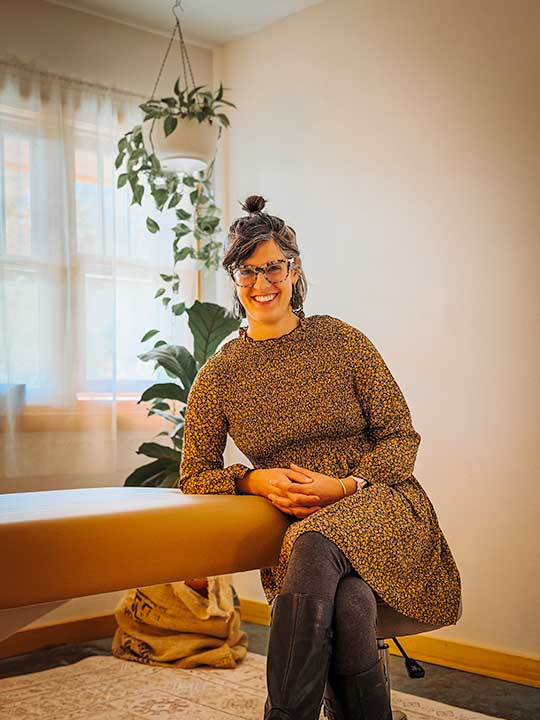
Dr. Chloe Waham owns The Wild Clinic, an osteopathic medical practice in Twisp.
Dr. Chloe Waham has opened an osteopathic medicine practice, The Wild Clinic, in Twisp. As an osteopath, she practices a holistic approach to healing that includes a range of hands-on modalities, and seeks to address the root causes of disease and imbalance.
Osteopathy is one of two ways to work as a fully licensed physician in the United States, said Waham. A physician may be licensed as an MD (Medical Doctor) or DO (Doctor of Osteopathy). Both educational paths include attending medical school and completing a residency. In addition, osteopaths receive extra training in the musculoskeletal system and hands-on modalities and treatment, said Waham.
Osteopaths are also taught to look at the whole person, Waham said, building on the tradition of osteopathy, which was developed by Dr. Andrew Taylor Still in the late 19th century to promote overall wellness.
According to the American Osteopathic Association’s 2026 Osteopathic Medical Profession Report, “Twenty-nine percent of medical students attend an osteopathic medical school today.”
Originally from Kirkland, Waham studied osteopathy at the Pacific Northwest University of Health Sciences in Yakima and completed an internship at the University of Vermont Medical Center in Burlington, focusing on anesthesiology. Her experience within the conventional medical system led her to return to osteopathic medicine, she said, as she came to see osteopathy as better aligned with “how we get better and why we weren’t well in the first place.”
Support for healing
“Our symptoms are communications; our bodies are letting us know that something is not aligned or not working anymore,” said Waham.
To treat both symptoms and the underlying imbalances, Waham uses a suite of manual healing methods known collectively as Osteopathic Manipulative Treatment (OMT).
Her web site describes OMT as “a gentle, hands-on approach that utilizes extensive knowledge of anatomy to help optimize the body’s structure to promote healing and maximize function. OMT is one tool that an osteopathic doctor can use to address the patient’s problems in a more holistic manner with the goal of avoiding/minimizing the use of pharmaceuticals or surgeries.”
One of the most important tenets of osteopathy, said Waham, is that “our bodies are capable of healing … they want to be well.”
Osteopathy “is most helpful for musculoskeletal related issues and pain,” she says on her web site.
It is “helpful for any stage of life,” Waham said in an interview — “perinatal, babies … kids, adults, aging bodies, end of life.”
Following a long osteopathic tradition, Waham offers a complimentary initial appointment for infants in the first month of life, noting on her web site that “infancy and early childhood are unique windows for treatment.”
A visit with Waham includes a thorough assessment, during which she’ll ask about the patient’s medical, social, and spiritual history and conduct a physical examination known as an osteopathic structural exam to evaluate any imbalances. Waham then selects the treatment she thinks will best address whatever restrictions the patient is facing.
The osteopathic treatment process is very tailored to individual needs, Waham said. She chooses from a variety of modalities, ranging from direct methods similar to chiropractic adjustments to subtler treatments such as craniosacral therapy. Waham said she tends toward indirect therapies.
Those modalities, she says, “are better tolerated, last longer, and let me get deeper into the body.”
Waham then offers her thoughts about any additional treatment that may help the patient. Most patients feel better and see improvement after one treatment, said Waham. When a condition has been in place for a long time, change often takes time, she said, and usually some effort.
Healing something that’s become chronic is “a different journey” than treating an acute injury, and can involve finding out what caused the imbalance and undertaking a process with a longer timeline. Waham will also refer interested patients to other practitioners — for movement therapy or psychotherapy, for instance. If a patient prefers, Waham will treat the presenting problem, she said, “and that’s the end of it.”
Working in community
Fostering collaboration is part of Waham’s intention for her practice, she said. That includes collaboration with other providers and modalities — “to build community, integrate, have people get back to their health, wellness, [and] vitality.”
In addition, she said, “It’s really important to me that my work brings people back to themselves, their own knowing, their bodies — and so in that way it’s also a collaboration” with patients.
Waham knew she wanted to return to the Pacific Northwest to practice, she said, and the Methow Valley appealed to her as a “smaller tighter-knit community” where she could live “close to nature.” She also appreciates the community’s orientation toward physical activity and caring for our bodies.
“We can all be doing what we love with our bodies to keep them well,” she said. “I love being in a community where that is a priority.”
Supporting that priority is an honor, said Waham, noting that she is “trying to bring something that’s needed and helpful” to the valley and “to be part of the solution” to local health challenges.
When asked why she chose to call her practice The Wild Clinic, Waham said the name “speaks to the undertones of what I want. When we’re well we feel wild, we feel free, we’re embodied and free of disease.”
The name is “about reclaiming my wildness and freedom, too — breaking out of everything we’ve been conditioned to understand about the world.”
One of the reasons she left mainstream medicine was to offer more options and spend more time with patients, said Waham. The Wild Clinic’s web site explains that “Initial appointments are scheduled for 60 minutes and follow up appointments for 45 minutes.”
As a sole practitioner, Waham works with each patient from start to finish. Her spacious consulting room sets a supportive tone with comfortable furniture, soft lighting, rugs underfoot, and a basket of toys for small children.
The Wild Clinic opened last winter and is growing, largely by word of mouth, said Waham. To learn more about osteopathic medicine and Waham’s practice, visit www.thewildclinic.com/. Appointments can be scheduled through the site; email healing@thewildclinic.com with questions. Waham does not provide primary care or medication management.


