
“An apple a day keeps the doctor away.” Sound familiar? I certainly remember my mother telling me that and, in turn, I repeated it to my sons (who still love a good apple).
The aphorism originated in Wales where it first appeared in a publication in 1866. The exact wording was slightly different. “Eat an apple on going to bed and you’ll keep the doctor from earning his bread.”
However, a study published in “JAMA Internal Medicine” in 2015 concluded that evidence of 8,399 study participants did not support that an apple a day keeps the doctor away. The good news is a small fraction of U.S. adults who eat an apple a day do appear to use fewer prescription medications.
Here in Washington state, there is no shortage of apples due to our state’s status as the largest apple producer in the U.S. Since most of us who live in the Methow Valley frequently make the trip down valley through the Wenatchee Valley orchards, we are fortunate to watch the cycle from the colorful blooming trees in spring to harvest of the laden branches in late summer and then the barren resting trees come winter.
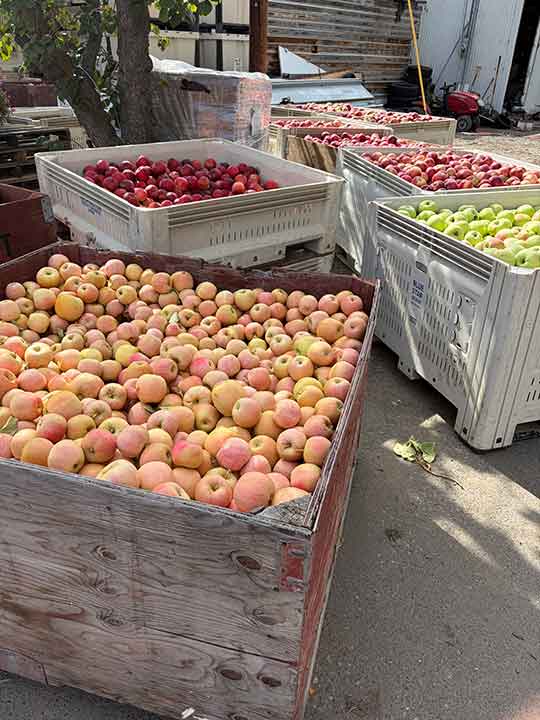
The advantage of living in apple country is being able to buy fresh apples at fruit stands.
The seemingly arduous task of picking all those apples has always been a marvel to me. Each tree appears to have hundreds of apples on it. The workers who do that job deserve copious praise for their industriousness.
Apple pickers are trained to use gentle techniques, holding each apple in the palm of their hand and rolling it upward until the stem breaks. Each apple is treated as if it is an egg. The apples are then gently placed from the picker’s bag into the big crates that we see stacked sky-high waiting for transport to the packing house.
Packing houses submerge the harvest bins in water tanks so the apples float out gently as they then make their way through the cleaning and washing stages on a water flume. High tech cameras spot hidden flaws or bruises and, if you are a bad apple, you get bumped off the belt — most likely destined to be juice or sauce.
The packing process typically occurs the same day the apples are harvested and the apples move from the packinghouse or storage facility to retail market shelves within days or less, according to US Apple, The Voice of the Apple Industry.
Living so close to apple country, we have the luxury of buying fresh apples at fruit stands where the many varieties produced are available to choose from.
As a kid, I remember two kinds of apples — red delicious and golden delicious. Now, Washington is home to over 30 types of apples with a wide range of flavor, texture, and color. The names range from Ambrosia to Dazzle to Lady Alice to Sugarbee. Old time favorites include Granny Smith, Braeburn, and Gala.
Most apple eaters have a favorite, but at the top in popularity is the Cosmic Crisp, which was developed right here in Washington state almost three decades ago by horticulturist Bruce Barritt and his team at Washington State University. Way back in 1997, he cross-pollinated a Honeycrisp apple with an Enterprise apple in his WSU research station. In 2013, a focus group named the new apple Cosmic Crisp because of the tiny white lenticels that look like a galaxy of stars.
The Cosmic Crisp variety was released to Washington growers in 2016 and still didn’t hit grocery store shelves until late 2019. If you have never tried a Cosmic Crisp, it’s worth the crunch. It is now one of the top-selling apple varieties in the U.S.


