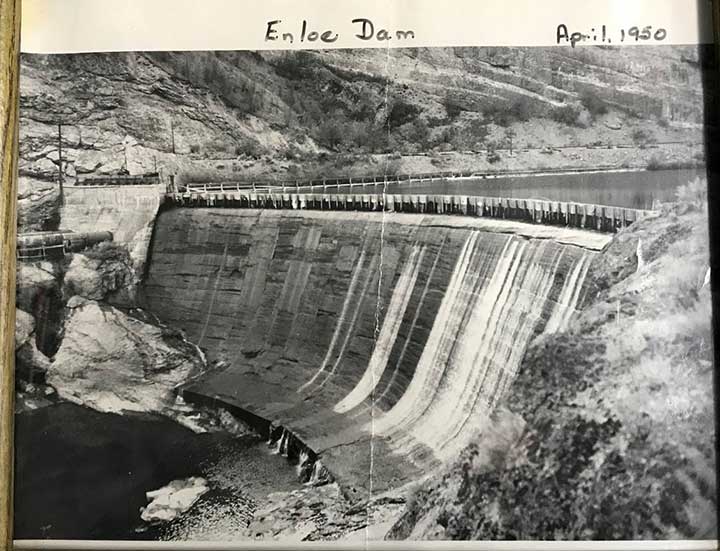
Consultants are working on a plan for the potential removal of Enloe Dam. The 104-year-old dam owned by the PUD (seen here in 1950) hasn’t produced hydropower in almost 70 years.
A detailed look at the future of Enloe Dam, the dormant dam on the Similkameen River owned by the Okanogan County Public Utility District (PUD), will be presented by the PUD and its independent technical consultant next week.
Organized by the PUD, the Enloe workshop will give PUD staff an opportunity to present responses to the initial feasibility study issued by Trout Unlimited (TU) and the Confederated Tribes of the Colville Reservation in January after more than two years of in-depth research by hydrologists, fish scientists and engineers.
The workshop is Monday (Oct. 5) from 6 to 9 p.m. at the PUD auditorium in Okanogan. The agenda and a link for attending remotely are on the PUD’s website at https://www.okanoganpud.org under “About Your PUD” and then “Board Meetings, Agendas and Minutes.”
PUD consultant Tetra Tech will provide its independent analysis of the study. The workshop includes time for public comment and a discussion with the PUD. No decisions will be made.
Determining the fate of the 104-year-old dam, which hasn’t produced hydropower in almost 70 years, includes many phases, starting with a conceptual design and then a feasibility study, before moving through several phases of design, from 30% to 60% to 90%, TU North Central Washington Senior Project Manager Michael Ward said this week.
Tetra Tech identified several important issues that require resolution before the project can move ahead with a detailed design or apply for permits for dam removal.
A chief concern is management of 560,000 cubic yards of sediment in the reservoir behind the dam. The feasibility study recommended allowing coarse sediment to flow downstream, but removing the fine sediment trapped behind the dam. There are concerns that sediment is contaminated with arsenic, which occurs at higher concentrations in fine sediment. Sampling has found that the majority of the sediment behind the dam is coarse.
“In our opinion, the Feasibility Study is a useful planning document, but it is not yet sufficient to support [PUD] Resolution 1775 and future decision regarding the management of Enloe Dam without further clarification and follow-up,” Tetra Tech said in a summary for the PUD about key issues and data gaps in the study. That 2022 PUD resolution supported evaluation of the potential for dam removal, with the requirement that parties find an entity to carry out the removal and guarantee complete indemnity for the PUD.
“Important sediment data are still missing, downstream irrigation and water quality impacts are not fully defined, construction access remains uncertain, and a final plan for mitigation has not yet been presented,” Tetra Tech said.
Design phases
Irrigators downstream of the dam also submitted comments to the PUD. The Oroville-Tonasket Irrigation District (OTID), which supplies 1,400 users who collectively irrigate 10,000 acres of orchards and farms, isn’t categorically opposed to dam removal, but the district requires assurances that avoid, minimize — and indemnify — irrigators from any effects of dam removal or release of arsenic-laden sediment, OTID said in a letter to the PUD in June.
Trout Unlimited and Stantec, TU’s technical consultant on the feasibility study and design, have continued to gather data and work on next steps since the feasibility study was released in January, with a goal of creating a 30% design document, Ward said. A 30% design includes a clear description of the project, rather than a set of alternatives for comparison, he said.
The feasibility study is just that — a look at whether dam removal is even possible, using the best-available science — while a 30% design document is the minimum requirement for submission to state and federal agencies for required permits. Responses from permitting agencies will provide additional crucial information about how to move forward, Ward said.
TU’s consultants are currently working on the 30% design for dam removal, which addresses many of the concerns raised by Tetra Tech and by irrigators, Ward said. An administrative draft of the 30% design document, for review by the PUD and stakeholders, is expected in a couple of weeks. That document will undergo five to six months of review before it’s released to the public, Ward said.
Tetra Tech maintains that sampling of sediment at deeper levels has not been completed and that plans for additional sampling won’t be completed in time for the removal plan at the 30% design level. Tetra Tech pointed to other components of the removal plan that haven’t been finalized, including mitigation measures and construction access. Cost estimates require a thorough review for consistency, Tetra Tech said.
Irrigators’ concerns
Tetra Tech also raised concerns about impacts on irrigators. Although Trout Unlimited is working with experts in irrigation systems and food safety, unresolved questions remain, Tetra Tech said. All this information is needed to inform the selected removal alternative, Tetra Tech said.
The 30% design document currently underway addresses most of the concerns raised by Tetra Tech and OTID, Ward said. It proposes removing about one-quarter of all sediment (sand and silt) for disposal — rather than allowing it to flow downstream — and will incorporate OTID’s recommendations for additional modeling and risk analysis, including input from irrigation and food-safety experts, TU said in its response to OTID this July.
Any plan should include mitigations to prevent damage to irrigation infrastructure and crops, not just compensation for post-impact claims, the irrigators said. They are concerned that accumulation of sediment could damage pumps, screens and other irrigation infrastructure, and that it could endanger crops or health.
OTID’s recommendations for additional modeling will inform engineering elements of the project design and be incorporated into subsequent designs and other planning documents, Ward said in response to OTID. TU will develop a community protection plan that includes mitigation measures to ensure that downstream irrigators, agriculture producers and private landowners are not saddled with problems from sediment or contaminants, he said.
The feasibility study concluded that dam removal is technically feasible, permits could be obtained, and the project would be affordable and could be insured, Trout Unlimited said. Removal of the dam would open 1,520 miles of habitat for salmon upstream of the dam in British Columbia, according to the study.
TU expects to identify a dam-removal entity by the end of this year, Ward said in the letter to OTID.
The feasibility assessment is at www.enloefeasibilityassessment.com.


