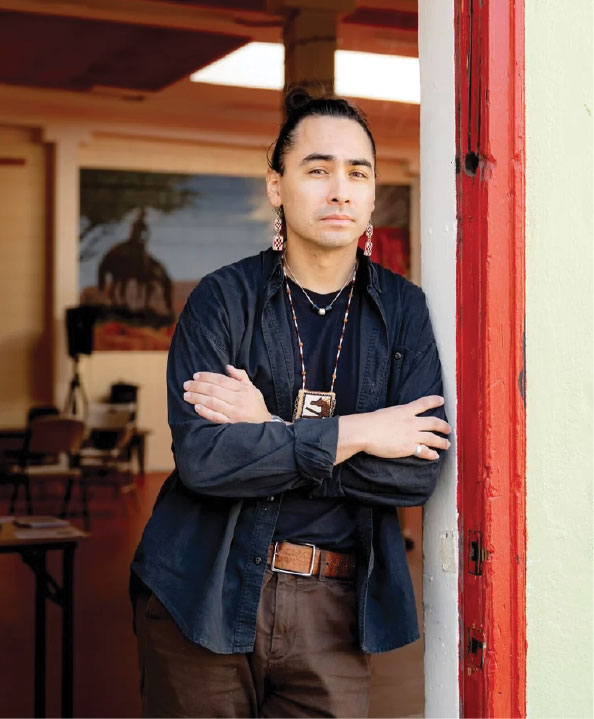
Julian Brave NoiseCat emphasizes the oral storytelling tradition in his works.
Julian Brave NoiseCat, award-winning author of “We Survived the Night,” and Oscar-nominated director of “Sugarcane,” will perform “The Epic Misadventures of the Trickster Coyote” in the lands of their creation on Wednesday, Oct. 28, at 7 p.m. in the Winthrop Barn.
Admission is by donation; all proceeds benefit 2026 fire relief efforts. The program is hosted by the Red Road Association, Sylix Okanogan Nation Alliance, Methow Valley Interpretive Center, River Warrior Society, and Nk’mip Desert Cultural Centre.
In an interview with NoiseCat, he described the Coyote Rivers Tour as “a revitalization of storytelling traditions of the greatest hits of Coyote,” featuring Columbia Basin waterways in an oral tradition with a contemporary spin.
The art of storytelling “gives people the opportunity to appreciate the depth and artistry traditions of this land,” NoiseCat said.
He is working with Indigenous and local leaders in British Columbia and Washington state to bring the Coyote Rivers Tour to the same rivers Coyote first populated with salmon and people millennia ago.
“I’ve been working on these presentations for a year,” he said, referencing his first show this year at a festival in the Hudson Valley, reviewed in The New York Times.
The Columbia Basin and rivers were formed during the Ice Age through glacial carving and floods — events recorded by Indigenous eye-witness accounts. Oral histories and placenames tell of megafloods rapidly displacing people and animals. Survivors of the great Ice Age floods passed down their narratives through 15,000-23,000 years of successive generations storytelling.
“Linguistic and cultural traditions that are similar along a geographic stretch indicates great antiquity,” said NoiseCat. The Coyote stories of floods traveled from the Pacific Northwest all the way to South America. The stories that survived since the Ice Age underscores the sophisticated practice of passing down true recollections, repeated and told over time combined with symbolism and metaphor.
In his book, “We Survived the Night,” NoiseCat shares stories of Coyote freeing salmon by breaking huge fish weirs — ice dams in the geological record. Temperatures and sea levels are once again rising; Indigenous memories may provide a model of continuity.
Oral history is a powerful assertion of existence. “Print culture is dying, the older generation is dying,” said NoiseCat. Oral storytelling is experiencing a renewal and a transformation through audio books and podcasts.
Written record historically fails to survive political upheaval. In contrast, indigenous oral traditions practiced through cultural discipline show longevity. Indigenous story telling encodes traditions, sustainable living, and long-term values that survive political and geographic upheaval.
NoiseCat is a member of the Canim Lake Band Tsq’escen and a descendant of the Lil’Wat Nation of British Columbia. He holds a graduate degree in global and imperial history from the University of Oxford. NoiseCat’s journalism has appeared in The New York Times, The Washington Post, and The New Yorker.
A selection of NoiseCat’s published articles can be found on his website, www.julianbravenoisecat.com/. NoiseCat’s documentary “Sugarcane” is distributed by National Geographic and can be streamed on Hulu. The book, “We Survived the Night: An Indigenous Reckoning,” can be purchased at Trail’s End Bookstore in Winthrop.


