
His parents didn’t know what to make of him — their bright son, who preferred to study a field guide or explore the natural world, venturing into forests, swamps, and mountains, or collecting and dissecting specimens. They didn’t discourage him, but wondered where his future lay. His teachers didn’t know what to do with him, a boy who wasn’t interested in what everyone else was doing, so they mostly left him alone, allowing him to educate himself with whatever caught his interest.
In an interview, David Lukas admitted that he doesn’t like formal education and didn’t complete his degree in English until his late 20s, and only after his long-time mentor, Gary Snyder — poet, essayist, lecturer, environmental activist and Pulitzer-Prize winner — advised him to finish what he started.
David’s affinity for the natural world inspired him to acquire knowledge experientially and through the study of his vast collection of books, primarily about natural science, ranging from the writings of famous naturalists to the most comprehensive collection of field guides I’ve ever encountered. Through autodidacticism, he became a professional naturalist.
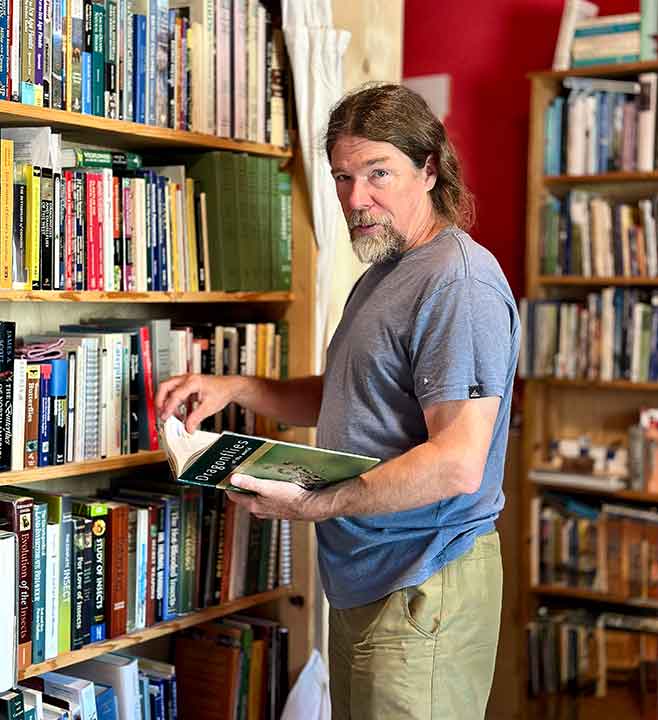
David was born and raised in Oregon. He has led thousands of walks, talks, classes, workshops and tours, including more than 10 years as a hiking guide and educator in Yosemite National Park. He is a prolific writer, having published dozens of books and hundreds of magazine articles. He now focuses his writing on his two newsletters, Lukas Guides and Methow Nature Notes, both available free or by subscription. From income earned from newsletter subscriptions, he’s able to spend time out in the field researching topics to write about and taking gorgeous photographs to accompany them.
Being out in the field, out in the natural world, is what David lives for. He said that when he’s home, he constantly studies and reads from his collection of books, but when he’s out in nature, he can let go and just let linkages and connections and webs of ideas happen spontaneously. He prefers to hike alone so that he’s free to explore whatever interests him, his senses wide open, picking up whatever he can smell, hear, or see. But he doesn’t shy away from contact with people. If someone needs help or wants to learn, he steps forward.
When asked whether he had trouble relating to people because of his intense absorption in the natural world, David said that there were long periods in his life when he disliked humans due to the way they were treating the natural world. But once he learned to connect with people through teaching natural history, giving talks, and having stories to share that changed people’s lives, he became aware that he had an awesome responsibility: that he could make a difference when he stepped into a role where he lost his self-consciousness and became a storyteller.
He said, “I believe that we’re all here together in this moment, and our job is to help each other. None of us knows what we’re doing or where we’re going; we’re just all trying to help each other understand the world and lift each other up however we can.”
In “A Sand County Almanac,” Aldo Leopold wrote: “One of the penalties of an ecological education is that one lives alone in a world of wounds. Much of the damage inflicted on land is quite invisible to laymen. An ecologist must either harden his shell and make believe that the consequences of science are none of his business, or he must be the doctor who sees the marks of death in a community that believes itself well and does not want to be told otherwise.”
In the August Lucas Guide Newsletter, David wrote an article entitled “Acknowledging Big Issues.” In this article, he explained the balancing act he performs between trying to address the big issues, issues that “threaten to change or end life as we know it,” and trying to engage people by focusing on small, inspiring topics. The choice he made, he wrote, was “to help people fall in love with the world and find their own path to advocacy, rather than telling people how badly things are going and how they need to act.”
He concludes with, “Paying attention and staying in the moment are the calling cards of a naturalist. I don’t need big joys or big wins as much when my days are filled with the small wonders of the world and this slow trickle of endless amazement helps me balance out the big issues that are always hovering in the background.”
David has amazing, informative videos on his YouTube channel: www.youtube.com/@DavidLukas.. Subscribe to his newsletters at: lukasguides.com and methownaturenotes.com.


