
Forest health treatments, thinning out mostly non-commercial trees from dog-hair stands, have, so far, been the best solution to minimizing the severity of wildfires. But, since little marketable timber is involved, they are expensive to undertake. The treatments also leave behind piles of biomass debris that, when burned, add more CO2 to the atmosphere and diminish air quality.
Reacting to the devastating impact of multiple wildfires, in 2019, Tom and Gina McCoy formed the nonprofit, C6 Forest to Farm, or C6 1.0, as the McCoys now call the defunct organization. Through the marketing of biochar made from the waste biomass created by forest health treatments and the sale of carbon credits, they had hoped to finance forest health treatments, making them more economically feasible and widespread. But the results of C6 1.0’s economic feasibility analysis showed that this couldn’t be done.
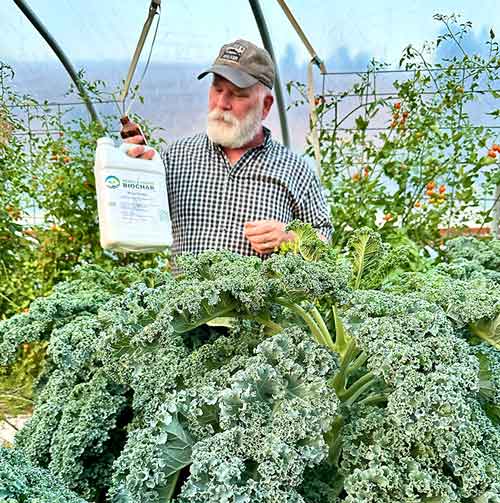
But Tom and Gina were determined to find a solution to this conundrum. Enter: pyroligneous acid (PA), or wood vinegar, as it is commonly known. The McCoys’ new nonprofit, C6 Innovations, is exploring the many benefits of PA, a byproduct of biochar production, benefits that could make this “liquid smoke” a very profitable substance.
Like biochar, PA has been used since ancient times, but more recently, its role in agriculture has emphasized its benefits for soil health and plant growth, as well as its natural pesticide properties. It has been used in wastewater treatment, as an additive to preserve freshness in food, as a deodorizer, as intestinal medicine, and as a sterilizing agent. In some areas of the world, like Japan, wood vinegar is valued for its cosmetic and health benefits. In an article by Graeme Sait, a renowned expert in soil health, plant health, and regenerative farming practices, soaking seeds in a 1:200 dilution of wood vinegar acts as a plant growth regulator, noticeably boosting plant growth and vigor. This remarkable product is also nematocidal and fungicidal while stimulating microbial growth in the soil.
The McCoys’ interest in PA was piqued when a mystery disease infested the tomato and pepper plants in their greenhouse. Using a dilute solution of PA from a company in New York state that had a pyrolysis reactor made specifically for generating PA, they sprayed down the plants. Within three weeks, the affected plants were not only free of disease, but were flourishing.
Through consultation with a colleague at the Agricultural Research Station, they learned of a study she conducted with PA. The fungus, Verticillium dahliae, has devastated the mint industry in the U.S. In the study, soil was saturated with PA and then planted with mint. The PA not only killed the Verticillium, but crop yields increased by 300%. As Tom quipped, “Everything bad dies, and everything good doubles.”
Tom said, “PA is a very complex compound. Depending on how you process it and what feedstocks you use, there’s a lot of variability.” Currently, the McCoys are at the stage of looking for the best place to focus their research. They have privately funded several field trials in the Columbia Basin focusing on the effect of PA on potatoes and several other crops, and they have sent samples of PA to WSU for more in-depth analysis. But, as Gina said, “We want to find the best applications for the type of PA that would be yielded from our local forests.”
Like biochar, PA is not well-known in mainstream agriculture, although it’s organically certified. Still, Tom sees enormous potential once the word is out about its many benefits and the specific qualities of PA from different feedstocks are defined. “PA has huge implications for food security globally,” he said. “Looking at the retail cost of PA, this product would make a biochar facility such as the one we planned with C6 1.0, not just economically viable, but very profitable at those prices.”


