
Eleven years after the Carlton Complex Fire, and smoke and wildfires almost every summer since then, it’s a blessed relief to experience more moderate temperatures and the rare occurrence of a few rainy days and nights, even though we’re experiencing our third year of drought. We can thank the timely efforts of our local, state, and federal wildland firefighters for containing fires — so far.
As The News noted last week, Tuesday, Aug.19 marked the 10th anniversary of the Twisp River Fire, where three firefighters lost their lives. I recently visited the Twisp River Horse Camp, which barely survived the blaze but was still heavily impacted. I haven’t been riding in the area for the past 10 years because most of the trails nearby have been impassable, but I have spent many hours with the Methow Valley Backcountry Horsemen clearing blowdowns and hazard trees from the camp.
The undergrowth along the Twisp River Road was lush this year, with abundant elderberries and chokecherries covering the bushes, somewhat compensating for the miles of blackened trees. Much of the forest beside the road had been heavily thinned, a controversial move to create a firebreak during the waning days of the Cedar Creek Fire. The last 4 miles of unpaved road to the horse camp were in good condition, but the road to the War Creek Trailhead was still washed out and unrepaired.
The horse camp was quiet and deserted except for the three of us, and looked nicely cleaned up and free of debris. But burned trees surrounded us. Ominously and not infrequently, even without wind, we heard the rumble of a falling tree, making us wonder how safe we would be riding in what we nicknamed “The Burnt Forest.” Burned trees fall so often that even if a trail has been recently cleared, you might encounter a newly fallen tree blocking your path (when on horseback) on the way back out. Packing a small saw helps, but some trees are too large to cut without a chainsaw or crosscut saw. I know a member of the Backcountry Horsemen who straps a 5-foot crosscut saw underneath the fender of her saddle so she can log out trails as she travels.
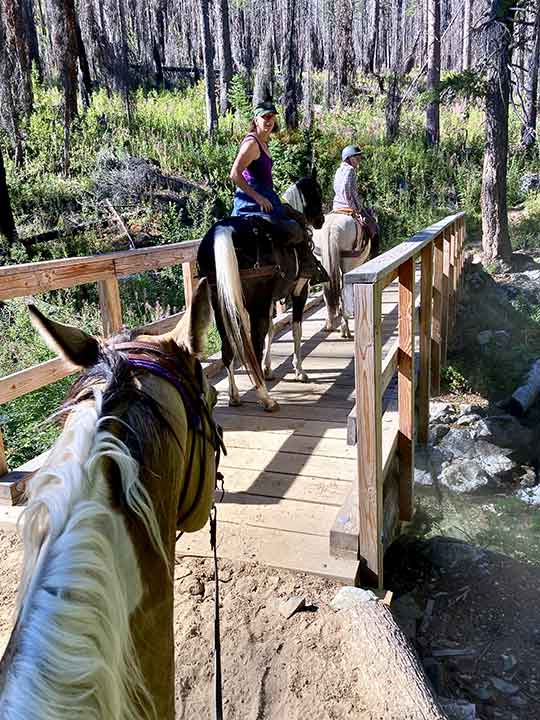
The Methow Trails Collaborative had recently replaced the bridge across South Creek, so the trail to Louis Lake was open, but we weren’t sure about access to other trails in the area. In 2018, the Gilbert Fire burned a large portion of the headwaters of the Twisp River. I knew we couldn’t go more than a couple of miles up the South Creek Trail. The South Creek Trail to South Pass has been closed for the past three years because the owner of an inholding that the trail crosses has blocked it off. Efforts by the U.S. Forest Service have been made to reroute this major trail, but so far, they’ve been unsuccessful.
On the first day, our trip to Louis Lake passed without mishap. We encountered several areas of downed trees that we were able to skirt, but none of them were “show stoppers,” as we call blowdowns that make the trail impassable for horses. The worst thing about traveling in The Burnt Forest is the heat. After the Twisp River Fire destroyed many trees, there was no canopy to provide shade, and the sun beat down. We breathed a sigh of relief and rested the horses when we hit a patch of live trees.
The North Creek and Twisp Pass trailhead is about 2.5 miles northwest of the horse camp, just past the old mining town of Gilbert. In the past, a trail accessed near the South Creek campground bypassed the Twisp River Road. Poorly maintained, the bypass trail was obscure. After thrashing over and skirting around numerous blowdowns, we returned to the road. We didn’t have much luck with the trail to North Lake. About a mile up the trail, we encountered show stoppers. We turned around and went up the trail to Twisp Pass, which was thankfully recently brushed and logged out.
It’s discouraging to encounter so many obstacles when trying to access our backcountry trails, especially on horseback, but also inspiring to see how many individuals and groups like the Methow Trails Collaborative, The Methow Valley Backcountry Horsemen, Evergreen Mountain Bike Alliance, and the Washington Trails Association, to name a few, are volunteering hundreds of hours to keep trails open. If you love our trails, donate to, join, and volunteer with one of these groups.


