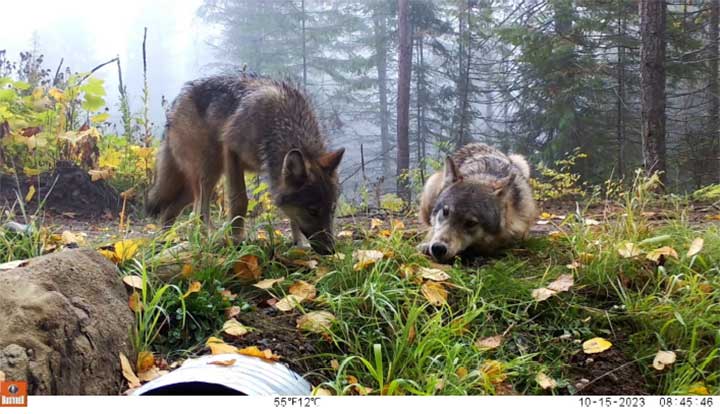
Four packs thriving in Methow Valley area
The number of endangered gray wolves in Washington increased last year by 20%, with at least 42 wolf packs in the north central and eastern part of the state.
An annual survey of wolves found four wolf packs with territories near the Methow Valley last year, the same as in the 2022 population survey conducted by the Washington Department of Fish and Wildlife (WDFW).
The 15th annual gray wolf count by WDFW, conducted as part of the state’s management of the endangered species, found that the number of individual wolves had grown from 216 wolves at the end of 2022 to 260 wolves at the end of 2023, an increase of 44 wolves.
The number of wolf packs increased from 37 in 2022 to 42 in 2023. The number of packs with successful breeding pairs, however, dropped from 26 in 2022 to 25 in 2023.
A breeding pair is a measurement of a pack’s reproductive success and is important to overall recovery of the species. It is defined as an adult male and female wolf that raised at least two pups that survived until the end of the year.
Among the four packs in the Methow Valley area, successful breeding pairs were found in the Lookout pack, which had 10 members, the Loup Loup pack, with five members, and the Sullivan Creek pack, with seven members. The Chewuch pack, with five members, did not have a successful breeding pair.
The survey found two new packs and four packs that became re-established last year in Washington. A pack is defined as two wolves traveling together during winter. One of the re-established packs, called Beaver Creek pack, is in the eastern part of Okanogan County and has two members.
Pack sizes range from two to 11 wolves. The Methow Valley’s Lookout pack is among the largest with 10 members. The Lookout pack is the oldest documented pack in the state, first discovered in 2008 occupying territory southwest of Twisp. Over the past 15 years the Lookout pack has survived poaching and wildfires.
Gauging recovery
Wolves are counted annually through tracking and aerial and camera surveys. The survey results represent a minimum count of wolves, WDFW said, due to the difficulty of accounting for every animal, especially lone wolves traveling without a pack.
The annual wolf count is conducted to help wildlife officials gauge the recovery of gray wolves, which were hunted and trapped into virtual extinction in Washington by the early 1900s. The surveys show the wolf population has grown by an average of 23% per year since the population monitoring began after the Lookout pack was found in 2008, WDFW said.
While wolf numbers grew last year, reported depredations on livestock or other domestic animals didn’t increase correspondingly, WDFW said. There were 23 confirmed or probable livestock depredations involving nine wolf packs last year, and only two packs were involved in two or more attacks on livestock, WDFW said.
The majority of wolf packs — 79% — were not involved in any attacks on livestock, even though many of the pack territories overlap livestock operations, WDFW said. The agency credited collaboration with livestock operators for limiting conflicts with wolves.
“Livestock producers have worked closely with WDFW staff in the past year, along with community partners and range riders, to use non-lethal methods to discourage wolves from negatively interacting with domestic animals,” said Ben Maletzke, WDFW statewide wolf specialist.
In addition to assisting with protective measures like range riders and fencing, WDFW also provided livestock producers with wolf location data to help identify high wolf-activity areas. The information enables producers to move livestock away from areas of high wolf activity and monitor livestock more closely.
“These proactive and reactive efforts require significant investments in time and resources by livestock operators and others but have reduced the number of wolf depredations and lethal removal of wolves,” Maletzke said.
Two wolves were killed by WDFW last year in response to wolf-livestock conflict, and another wolf was killed by a livestock owner while caught in the act of attacking livestock, WDFW reported. In 2022, six wolves were killed under WDFW authorization due to livestock conflicts. All lethal removal of wolves took place in eastern Washington.
Another 33 wolves died in 2023, including 22 that were killed by tribal hunters of the Confederated Tribes of the Colville Reservation, which permits hunting, trapping and snaring of wolves on tribal lands.
Five wolves were killed by vehicles and one was killed by a cougar. Of the remaining five known deaths, four are under investigation and one died of unknown causes, WDFW said.
WDFW said investigations into the killings of wolves from the Smackout pack and Wedge pack in 2021 in the eastern part of the state have reached the statute of limitations and the investigations are closed. The investigation into the unlawful poisoning of six wolves from the Wedge pack in 2022 has also reached the statute of limitations and the investigation is closed.
Monitoring wolves
WDFW said it spent over $1.6 million on wolf management activities in 2023, including research, working with livestock owners, contracting for range riders, paying claims for livestock losses, and lethal removal.
Biologists captured 33 wolves from 22 different packs in 2023 and placed radio collars on them, making a total of 52 radio-collared wolves from 25 packs that were monitored during the year. The collars allowed biologists to track the movements of 11 wolves that dispersed from their packs.
Two of the dispersing wolves were from the Loup Loup pack near the Methow Valley. One was killed by a vehicle while attempting to cross I-90 near Cle Elum, and the other traveled north into British Columbia and then moved back south into the Lookout pack territory.
Several other collared wolves dispersed south of I-90 last year, although the southern part of the state had no established packs as of the end of 2023.
As part of Washington’s wolf management and recovery plan, created in 2011, the state is divided into three “recovery zones” — Eastern, Northern Cascades (which includes the Methow Valley), and Southern Cascades and Northwest Coast.
Both the Eastern and Northern Cascades recovery zones have exceeded minimum recovery goals outlined in the state wolf management plan during the past two years. Those goals require at least four successful breeding pairs in the recovery zone for three consecutive years.
In its 2022 survey, WDFW found two wolves in Klickitat County, which was the first pack identified in the Southern Cascades and Northwest Coast recovery region. By the end of 2023, however, only one wolf was found in the region. WDFW officials hope that wolves will become established in all regions to meet recovery goals.
Proposed downlisting
Since 1980, gray wolves have been protected under state law as an endangered species throughout Washington. The status of gray wolves under federal law has been debated and litigated for many years, and the level of protection for the species has changed several times.
Wolves in the lower 48 states were listed as a federally endangered species in 1978. Under the Trump administration in 2021, wolves were removed from federal endangered species listing. That was reversed in February 2022, when a federal court ordered wolves relisted as endangered or threatened under federal law across the continental United States.
However, wolves in the eastern third of Washington are considered part of a distinct population of northern Rocky Mountain wolves, along with wolves in Idaho, Montana, eastern Oregon and northern Utah. Wolves in these areas lost federal protections in 2011 as a result of legislation passed by Congress, and have been managed by the states.
As a result, wolves in the western two-thirds of Washington, including the Methow Valley, are managed under federal jurisdiction (U.S. Fish and Wildlife Service) and listed as endangered under both federal and state law. Wolves in eastern third of Washington — where the majority of the state’s wolves (33 of the 42 packs last year) are found — are managed under state jurisdiction (WDFW) and listed as a state endangered species.
Under the state’s Wolf Conservation and Management Plan, wolves can be removed from the state’s endangered species list when at least four successful breeding pairs are present in each recovery region, and there are three additional breeding pairs anywhere in the state for three consecutive years; or when there are at least four successful breeding pairs in each recovery region and six additional breeding pairs anywhere in the state for a single year.
Although the annual survey shows continued overall growth in the state’s wolf population, the increase is not enough to justify a recommendation by WDFW to reclassify gray wolves in Washington as a “sensitive” species rather than an endangered species, said Amaroque Weiss, a wolf advocate with the Center for Biological Diversity.
In February this year, WDFW announced a proposal to downlist gray wolves, as a result of a periodic status review that is required every five years for wildlife species that are listed by the state as endangered, threatened or sensitive.
WDFW said it based its decision on 14 years of data and wolf population trends, and on a new population model developed at the University of Washington. In the western two-thirds of Washington (including the Methow Valley) where wolves are currently protected under the ESA, the proposed change in the state listing would not affect wolves’ federal status.
Weiss said downlisting wolves not warranted because Washington has not met its statewide recovery goals, since no breeding pairs are established in the Southern Cascades and North Coast recovery zone.
“Real progress requires a continued commitment to provide strong protections to wolves so they can safely disperse into all three recovery regions and establish territories and families there,” Weiss said.
“I’m pleased to see the agency (WDFW) greatly reduced its own killing of wolves this year,” Weiss added. “Instead of bending to political pressure from wolf opponents, the department should continue to focus on nonlethal (conflict) prevention measures and education.”
Downlisting wolves from endangered to sensitive would maintain prohibitions on hunting and malicious and intentional harassment of gray wolves. However it would change management and protection for wolves, including reducing criminal penalties for killing wolves, and loosening restrictions on permits for lethal control and actions that can be taken in critical habitats.
WDFW is taking public comment on its recommended downlisting until May 6. Information on the proposal and how to comment is available at: publicinput.com/sepa_graywolf.
WDFW submits its annual report on wolf population and management activities to the federal government as a requirement of the Endangered Species Act. Contributors to the annual report include the U.S. Fish and Wildlife Service, the National Park Service, and tribes.
The full report can be found on WDFW’s website at: wdfw.wa.gov.


