Retiring wildlife officer Cal Treser reflects on his 36-year career
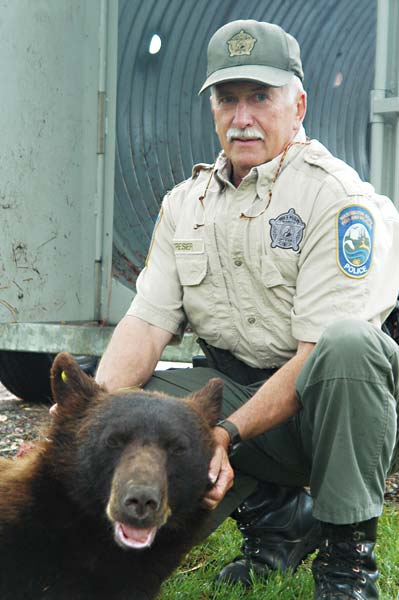
Cal Treser: his heart was always in the job.
By Ann McCreary
Driving up a mountain road on his way to release a problem black bear on a recent Sunday afternoon, Cal Treser said his 36-year career as a state fish and wildlife police officer was coming to a close on a good note.
“I’ve had a wonderful weekend,” said Treser as he drove his Washington Department of Fish and Wildlife (WDFW) truck up Boulder Creek Road north of Winthrop. “I’ve had three different bear complaints, I trapped a bear, and I caught violators fishing without a license and fishing illegally with bait.”
Along with two other officers, Treser released the bear from its trap and scared it into the woods by firing cracker shells and paint balls, hopefully making it dislike humans enough to stay away from homes and livestock and out of trouble (see related story on this page).
Many Methow Valley residents know Treser as the WDFW officer who responds at all hours when they call with cougar or bear problems. For 16 years, Treser’s patrol area has included the Methow Valley, where he makes his home.
Treser will retire from WDFW on May 31, ending a career that has earned him the respect of his peers and the public.
“The No. 1 thing that will be missed is his work ethic and his ability to communicate with all sorts of people, from all walks of life. Cal can communicate with everyone,” said Jim Brown, WDFW regional director, who has worked with Treser for 24 years.
“He has a lot of respect in the community. He could always be counted on to do what was needed and then some,” Brown said. “The relationships he built in the Methow Valley won’t be easily replaced.”
“Dealing with dangerous wildlife is kind of the high-profile, high-visibility part of the job,” Treser said last weekend after the black bear, which had developed a taste for goats, was released far from the scene of the crime.
“But my heart is in law enforcement,” he said. “I love catching violators. They’re not playing fair. They’re cheating, destroying resources. The only thing that stands between extinction of our wildlife is law enforcement. Our job is to level the playing field.”
Well respected
Treser is “a game warden’s game warden,” said Dan Christensen, WDFW police supervisor for Okanogan County. “He makes you want to deliver that same level of dedication to the resource.”
Christensen described Treser as a “quiet, mild, humble man.” Treser was named WDFW’s officer of the year this year, an honor that is voted on by peers in the agency.
Treser began his career in the Department of Fisheries, before the state fish and wildlife departments merged into one agency. A decorated veteran of the Vietnam War, where he was an Army Ranger, Treser trained in law enforcement when he returned home from the war because he knew he wanted to be a game warden.
His career included working in ocean fisheries on the Washington coast, and working in fisheries in the Yakima area. In 1999, five years after the fisheries and wildlife departments consolidated into WDFW, Treser transferred to the Methow Valley.
His duty station includes the northwestern quarter of Okanogan County, a vast area of about 2,000 square miles — from Chesaw to Pateros to Mazama — much of it backcountry and wilderness.
Living and working in the Methow Valley “is so much different than working in other areas,” Treser said. “When you’re the only person working in a small community, everybody knows you. If you arrest someone, your wife knows about it before you get home.”
The pre-eminent wildlife issue in the Methow Valley is big game, Treser said. With the largest migratory mule deer herd in the state, plus white-tail deer, bear and cougar, much of the wildlife enforcement activity here is related to those large animals.
“Cal’s handling of cougar and bear complaints in the valley stands out to me,” said Brown. “As well as his doggedness on working deer season and deer hunter-related conflicts. That’s a big part of the Methow wildlife officer’s responsibility.”
Changes over time
For many years, Treser led a horse patrol program, riding deep into the mountains during hunting season to monitor hunting activity.
Treser said he’s seen wildlife management changes over the years that have impacted his work, particularly statewide bans approved in the mid-1990s on bear baiting and hunting cougar and bear with hounds. The result was an increase in the population of cougars and bears and a corresponding increase in complaints, he said.
The growing population of humans in the valley is an equally important contributor to wildlife conflicts, he said.
“As we have more and more people moving into the valley, we have more complaints. They don’t understand they just moved into cougar habitat,” Treser said.
“Most problems with wildlife are really people problems,” Treser said. Garbage left in containers or cars that aren’t bear-proof, dogs and cats left out at night, livestock that isn’t adequately protected, and people who deliberately feed wildlife are the causes of many of the issues he and his colleagues deal with.
“A fed bear is a dead bear,” Treser said. “Leave the wildlife alone.”
Working to enforce state hunting and fishing laws and protect the natural resources has involved patience, occasional foot chases, and even a couple of threats to his life, he said.
“Most hunters and fishermen are really, really great. They obey the law, they are out to recreate with their families. But you get that one person who thinks they don’t need to follow the rules,” Treser said.
Enforcing hunting and fishing laws often involves observing from a distance, he said. From a hidden location by a lake, for instance, Treser would watch fishermen to determine if they are complying with regulations.
“You know what they’re doing before you contact them. You see people pulling bait out or hiding fish. It’s a lot more fun … because they’ll lie to you,” he said with a smile. “You get their fishing license and driver’s license. Once you get that you can say, ‘What’s that green stuff on your fingers?’”
Occasionally, people will respond by attempting to flee, he said. “I can’t tell you how many foot chases I’ve been in,” Treser said.
Ready for solitude
One of the most complicated and rewarding cases Treser worked was a bear baiting case in the Cub Creek area near Winthrop that concluded three years ago. Treser and other law enforcement agents worked for several years gathering evidence, which resulted in the conviction of an Eatonville, Washington, man, family members and friends on multiple charges of bear baiting and illegally killing bears.
In addition to his regular duties with WDFW, Treser has also served as WDFW’s master firearms instructor for many years; taught defensive tactics courses; and was an instructor for the Law Enforcement Mountain Operations School, where he taught cold weather operations and survival.
Being the only officer assigned to such a large area means that work is often 24 hours a day, seven days a week. When Treser, 66, decided about a year ago that he was ready to retire, he knew he’d be facing a big change.
“It’s not just a job. This is your life. It’s a lifestyle. I prepared myself mentally,” he said.
“After 36 years of dealing with the public in law enforcement, I’m going to become a little bit of a recluse,” Treser said.
He’s already planning an ambitious getaway — a solo backpacking trip from April through October next year on the 2,700-mile Pacific Crest Trail from Mexico to Canada.


