
Pretty much every time I go out and about in the Methow Valley, I learn something new. Sometimes I learn about who used to be married to who, or who used to have what job or own which business. Once I introduced two sisters to each other, not realizing that their relationship with each other far eclipsed mine with either of them.
Today, I learned something that I wish I had known earlier in my life: the existence of a critter called a puffling. I can’t believe I never knew this; I lived in Maine for decades! I have seen puffin nesting colonies on its coastal islands. It just never occurred to me that puffin offspring might have their own baby animal names.
My neighbors Gisèle and Alan Sodell clued me in to this enchanting knowledge. The Sodells, who explore the Methow Valley extensively, try to do at least one “off-campus” trip each year, getting to know other parts of the world. Their recent trip to Iceland gave them the opportunity to learn about Atlantic puffins and their adorable, sometimes wayward, pufflings.
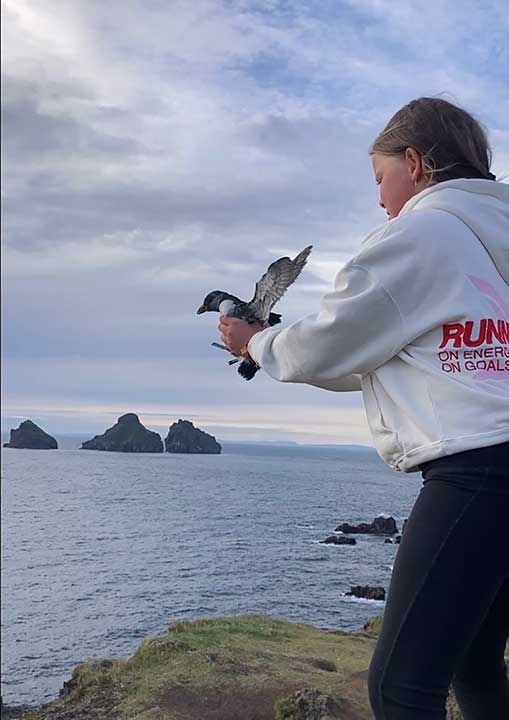
Puffling releases are common in Iceland at the end of summer, to help the young birds learn to navigate.
The waywardness is fully attributable to the fact that humans have messed up birds’ ability to navigate using natural light, given our dependence on artificial light.
Puffins live in the open North Atlantic but return to land in the late spring to breed, nest in burrows, and raise their chicks. In late summer, it’s time for the pufflings to learn to fly, and fly they do, but unfortunately city lights can distract them and they frequently end up in towns, clustered in well-lit areas like parking lots, hospitals, and gas stations.
So residents of puffin-dense towns collect the stranded pufflings in the night and the next day release them off seaside cliffs, above the ocean they had been seeking when bright lights pulled them off course.
The Sodells recently witnessed this catch and release practice on Heimaey Island, the largest in the Vestmannaeyjar archipelago off the south coast of Iceland and the only inhabited island of the Westman Islands. Apparently it is quite common for children and teens to participate in the puffling release, as their parents teach them what has become necessary since city lighting has disrupted normal migration.
Gisèle said that the young rescuers cup a puffling in two hands, with its wings free. They lift it a few times in an underhand motion, so it gets the feel of the wind under its wings, and then release it in an upward toss. The puffling gets its bearings and soars out to sea, the daylight providing the fledgling a clear view of the ocean, the next generations of both humans and birds united in an adaptive practice that restores natural rhythms.


